

Dr. Sidharth Verma
15th August, 2026
8 min
Medically Reviewed By:
Dr. Sidharth Verma | 12+ Years Of Experience Treating Pain | Pain Management Specialist
Last Updated: 11th August, 2026
Spending eight or more hours at a desk is common for working professionals. A desk job does not automatically “damage” your spine, but prolonged sitting, too little movement and an unsuitable workstation can contribute to or aggravate neck and lower-back pain.
The solution is not to find one “perfect posture” and hold it all day.
Your spine and muscles benefit from movement, variation and physical conditioning.
Here are five common desk-job habits that may contribute to back pain—and what you can do about them.
Staying in the same position for hours can lead to:
A reminder every 30–60 minutes may help some people, but there is no single compulsory interval for everyone. The important thing is regular movement rather than prolonged static sitting.
OSHA (Occupational Safety and Health Administration, USA) recommends arranging computer work to support neutral body positions while also taking regular breaks and changing position.
Poorly supported positions can contribute to discomfort, but there is no single perfect posture that needs to be maintained throughout the day.
A comfortable desk position generally includes:
The best posture is often your next posture, change position periodically instead of trying to sit rigidly for hours.
OSHA recommends neutral joint positioning and appropriate workstation adjustment to reduce musculoskeletal strain.
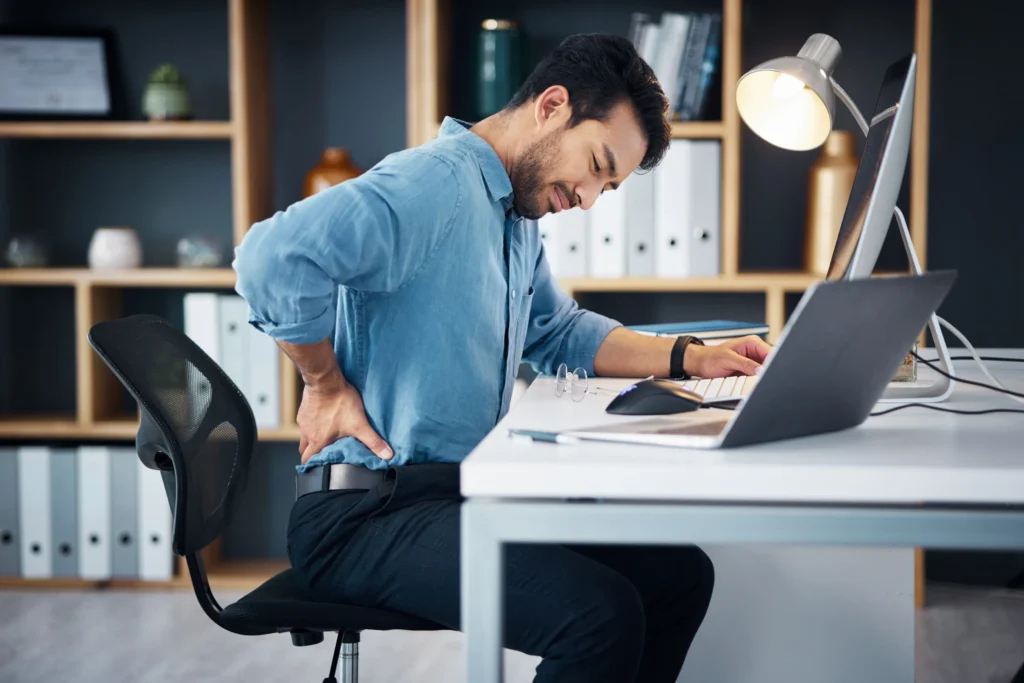
A poorly arranged workstation can make you repeatedly lean, reach or bend your neck.
Common problems include:
Consider:
Ergonomics alone cannot compensate for an otherwise inactive lifestyle.
Regular physical activity helps maintain:
Depending on your condition, exercise may include:
There is no single “best core exercise” for every back-pain patient. Exercise should be tolerable and progressively increased.
WHO recommends structured education, exercise and individualised multicomponent care for chronic primary lower-back pain rather than relying on one isolated treatment.
This is probably the most important mistake.
A desk worker can develop back pain from causes unrelated or only partly related to sitting.
Persistent pain may arise from conditions such as:
If improving your workstation and movement habits does not improve the problem, the next step should be to identify the pain generator rather than repeatedly blaming posture.
Consider medical evaluation if:
Routine MRI is not required for every episode of uncomplicated lower-back pain. Imaging becomes more useful when warning signs, neurological findings, persistent symptoms or treatment planning make it clinically relevant.
Seek urgent hospital assessment if back pain is accompanied by:
Treatment depends on the diagnosis rather than the patient’s occupation alone.
For many patients, treatment may include:
Medication can be useful, but persistent pain should not simply lead to repeated painkiller prescriptions without reassessing the cause.
MIPSI stands for Minimally Invasive Pain and Spine Interventions.
The Indian Society for the Study of Pain describes MIPSI as a structured domain of image-guided diagnostic and therapeutic interventions for appropriately selected pain conditions.
A desk job by itself is not an indication for a procedure.
MIPSI may become relevant when:
Depending on the diagnosis, options may include:
May be considered in selected patients with sciatica or nerve-root pain.
May be considered when chronic pain appears to arise from the lumbar facet joints.
Radiofrequency ablation should not be recommended simply because an MRI shows facet arthritis. Appropriate diagnostic confirmation is important.
May be considered when clinical assessment suggests that the sacroiliac joint is a significant pain generator. Injection of Radiofrequency ablation may be considered.
Selected patients with a clinically significant disc herniation or nerve compression may be evaluated for minimally invasive spine endoscopy.
It is not required for ordinary desk-related back pain.
Painacea is neither medicine-only nor procedure-first.
The approach is:
Understand the pain → identify the likely pain generator → correct movement and ergonomic factors → use rehabilitation and medication appropriately → consider MIPSI only when indicated → consider endoscopy or surgery when required.
The first consultation may therefore result in:
The treatment is selected according to the diagnosis—not because the patient happens to work at a desk.
Try to:
Small sustainable changes are generally more useful than trying to maintain a rigid “perfect” posture throughout the day.
Prolonged static sitting, insufficient movement and an unsuitable workstation can contribute to or aggravate lower-back discomfort. A desk job does not automatically mean that your spine is being structurally damaged.
Not always. Posture is only one factor. Activity level, movement variability, physical conditioning, sleep, stress and underlying spinal conditions may also contribute.
There is no single medically compulsory interval. Change position and move regularly rather than remaining still for prolonged periods.
A sit–stand desk can make it easier to change position, but standing all day is not necessarily better. The goal is variation, not replacing prolonged sitting with prolonged standing.
Not necessarily. MRI is considered when symptoms, neurological findings, warning signs or treatment planning make it clinically useful.
Usually not for simple desk-related discomfort. A diagnostic or therapeutic MIPSI is considered only when evaluation identifies an appropriate pain generator and indication.
Consider evaluation if pain persists, repeatedly returns, affects work or sleep, travels into the leg, or is accompanied by numbness or weakness.

Dr. (Prof) Sidharth Verma is an interventional spine and pain physician with over 17 years of experience in treating chronic pain patients. His work focuses on a precision-driven, minimally invasive approach. His clinical work is centered on Minimally Invasive Pain & Spine Interventions (MIPSI), involving image-guided techniques for targeted pain management.
Dr. Sidharth Verma
15th August, 2026

Dr. Sidharth Verma
15th August, 2026

Dr. Sidharth Verma
14th August, 2026
A consultation can help determine appropriate next steps based on your condition.
125, B wing, First floor, Shrikant Chambers, Next to RK Studios, Chembur, Mumbai, Maharashtra 400071


