

Dr. Sidharth Verma
15th August, 2026
7 min
Medically Reviewed By:
Dr. Sidharth Verma | 12+ Years Of Experience Treating Pain | Pain Management Specialist
Last Updated: 15th August, 2026
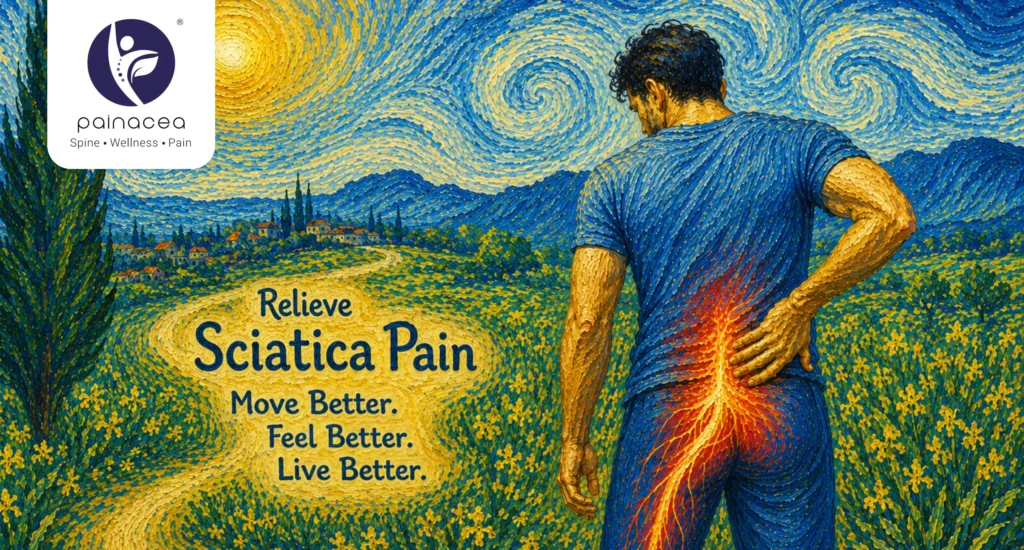
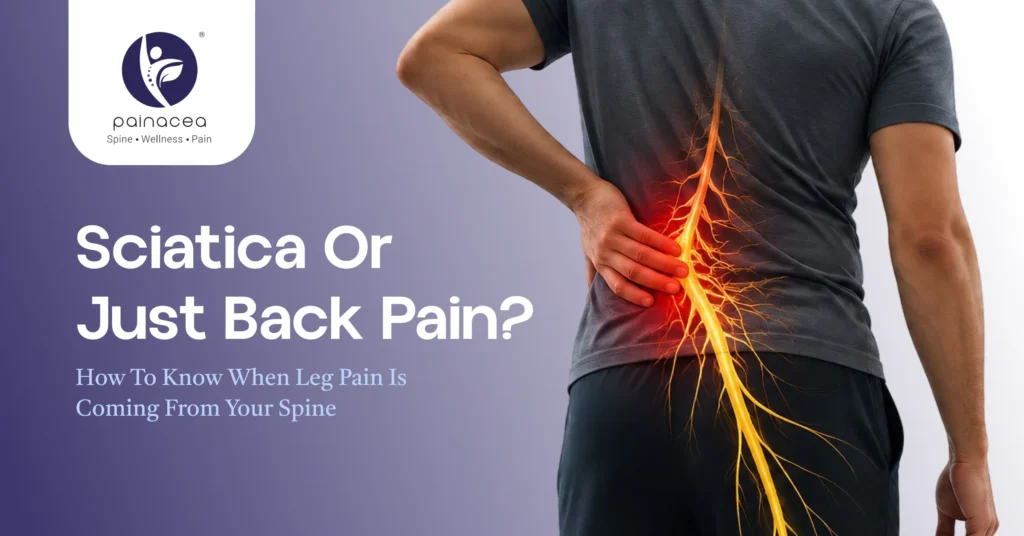
Sciatica can make sitting, walking, working and sleeping difficult. Pain typically travels from the lower back or buttock into the thigh, leg or foot and may be accompanied by tingling, numbness or weakness.
But not every leg pain is sciatica.
Spine-related sciatica usually occurs when a lumbar or sacral nerve root is irritated or compressed. Hip, sacroiliac-joint, muscular, vascular and peripheral-nerve conditions can sometimes produce similar symptoms.
At Painacea, the first step is therefore to identify whether the pain is truly sciatica, which nerve may be involved and what is causing it before deciding on treatment.
Symptoms may include:
Some patients have severe leg pain with very little back pain.
Read More → Sciatica vs Back Pain
A disc herniation can irritate or compress a nearby spinal nerve root.
This may cause pain travelling into the leg, sometimes with numbness, tingling or weakness.
Not every disc bulge causes symptoms, and not every slipped disc requires surgery.
Narrowing around a spinal nerve may cause:
One vertebra may move relative to another and reduce the space available around spinal nerves.
Whether this is actually responsible for symptoms depends on the clinical findings and imaging.
Less commonly, the sciatic nerve itself may be irritated in the deep-gluteal region outside the spine.
This is different from typical spine-related sciatica, which usually involves a lumbar or sacral nerve root.
If there are no emergency warning signs, many patients can initially use simple self-care.
Prolonged bed rest is generally not helpful.
Try to:
NHS guidance encourages staying active and avoiding prolonged sitting or lying down during sciatica recovery.
You do not need to push through severe or clearly worsening neurological symptoms.
If prolonged sitting, repeated bending, twisting or heavy lifting markedly aggravates leg pain, temporarily reduce these activities.
The aim is temporary modification—not permanent avoidance.
Gentle heat may provide temporary comfort for some patients.
Avoid excessive heat over areas with reduced sensation because burns may go unnoticed.
Usually, some form of gradual activity or rehabilitation is useful, but there is no single “sciatica exercise” that works for everyone.
Depending on the diagnosis, rehabilitation may involve:
Exercise should be adapted to symptoms and neurological findings.
Stop and seek assessment if exercise is associated with:
Seek immediate emergency assessment if back or leg pain occurs with:
These may be features of cauda equina syndrome, which requires emergency assessment.
Prompt assessment is also important for:
Consider medical assessment when:
Neurological changes such as increasing weakness or loss of sensation are often more important than the pain score alone.
Assessment may include:
The aim is to identify:
No.
NICE advises against routine imaging for low-back pain with or without sciatica in a non-specialist setting. Imaging in specialist care should generally be requested when the result is likely to change management.
MRI becomes more relevant when:
ACR similarly supports MRI in appropriate persistent/progressive radiculopathy and suspected cauda equina syndrome rather than routine imaging for every episode.
Most importantly:
An MRI abnormality must be correlated with the symptoms and examination.
A disc bulge does not automatically prove that it is causing the pain.
Painacea follows a:
Diagnosis First → Targeted Treatment Next
approach.
Treatment depends on the cause, severity, neurological findings and impact on daily function.
Initial treatment may include:
Medication can have a role, but persistent nerve pain should not simply result in repeated painkiller prescriptions without reassessing the diagnosis.
MIPSI stands for Minimally Invasive Pain and Spine Interventions.
Not every patient with sciatica requires an intervention.
MIPSI may become appropriate when:
A Transforaminal Epidural MIPSI delivers medication close to the affected spinal nerve root under fluoroscopic image guidance.
The Indian Society for the Study of Pain specifically describes this approach for selected patients with:
The aim may be to:
It does not mechanically remove a disc prolapse.
NICE also recommends considering epidural local anaesthetic and steroid for acute and severe sciatica.
In selected patients, an image-guided selective nerve-root procedure may help when:
It may therefore have a diagnostic as well as therapeutic role.
Conventional lumbar medial-branch RFA is not a routine treatment for ordinary disc-related sciatica.
It is primarily used for appropriately selected facet-joint-mediated back pain, rather than for decompressing a spinal nerve root.
This distinction should be clear so that different MIPSI procedures are not presented as interchangeable.
Some patients have a clearly identifiable disc herniation or foraminal compression that continues to produce significant sciatica despite appropriate non-surgical treatment.
When the symptoms, neurological examination and imaging correlate, selected patients may be evaluated for a minimally invasive spine-endoscopic decompression.
Possible approaches may include:
Spine endoscopy is not required for every slipped disc or every case of sciatica.
Most patients with sciatica do not require surgery.
However, surgical evaluation becomes important when:
NICE recommends considering spinal decompression when non-surgical treatment has not improved pain or function and the radiological findings are consistent with the patient’s sciatic symptoms.
Painacea’s objective is not to avoid surgery at all costs.
It is to identify patients who can appropriately be managed non-surgically while ensuring necessary decompression is not delayed.
Recovery varies according to:
Many episodes improve over several weeks, although some persist longer or recur. NHS patient guidance describes improvement over time with continued activity as common, while recognising that recovery may take weeks.
No exercise, medicine, injection or procedure should be presented as a guaranteed permanent cure.
Consider specialist evaluation if:
Painacea is neither medicine-only nor procedure-first.
The pathway is:
Confirm sciatica → identify the affected nerve and cause → begin with the least invasive appropriate treatment → use MIPSI when indicated → consider spine endoscopy or surgery when required.
A patient may therefore leave the first consultation with:
Treatment follows diagnosis — not the other way around.
The two specialties are not competitors. The right specialist depends on what is causing the problem and what treatment it requires.
Booking a consultation does not mean that an injection or procedure will automatically be recommended.
Yes. Some people have predominantly buttock and leg pain with very little lower-back pain.
Gentle walking and continued activity are usually reasonable when tolerated. Seek assessment if weakness, numbness or walking ability progressively worsens.
No single stretch treats every cause of sciatica. Exercise should be selected according to the diagnosis and symptoms.
No. Many patients improve without an intervention. MIPSI is considered only when there is an appropriate indication.
No. Imaging is selected when it is likely to alter diagnosis or treatment rather than performed routinely.
Yes. Many patients can be managed without surgery. Selected persistent cases may benefit from MIPSI, while some compressive conditions require endoscopic or conventional surgical decompression.
No. Its purpose is to deliver medication around the irritated nerve region and reduce inflammation and symptoms; it does not mechanically remove the disc.

Dr. (Prof) Sidharth Verma is an interventional spine and pain physician with over 17 years of experience in treating chronic pain patients. His work focuses on a precision-driven, minimally invasive approach. His clinical work is centered on Minimally Invasive Pain & Spine Interventions (MIPSI), involving image-guided techniques for targeted pain management.
Dr. Sidharth Verma
15th August, 2026
Dr. Sidharth Verma
14th August, 2026
Dr. Sidharth Verma
14th August, 2026
A consultation can help determine appropriate next steps based on your condition.
125, B wing, First floor, Shrikant Chambers, Next to RK Studios, Chembur, Mumbai, Maharashtra 400071


