
Dr. Sidharth Verma
17th August, 2026
10 min
Reviewed By:
Dr. Sidharth Verma | 12+ Years Of Experience Treating Pain | Pain Management Specialist
Last Updated: 17th August, 2026
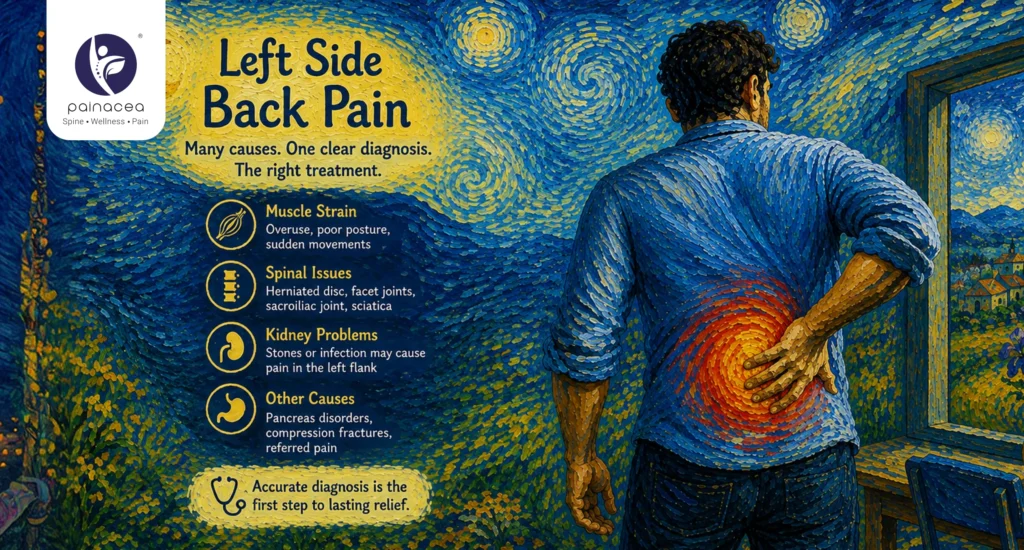
Pain on the left side of your back can arise from many different structures.
It may begin after lifting or exercise, gradually develop during prolonged sitting, travel into the leg, or occasionally come from a kidney or another internal organ.
The important point is:
The side of the pain alone does not identify the cause.
At Painacea, the first step is to determine:
“Left-sided back pain” can mean pain in several different regions.
Pain may be felt:
Possible causes include muscles, ribs, thoracic joints, referred shoulder or neck pain and, less commonly, internal-organ conditions.
Flank pain is usually felt below the ribs and towards the side of the body.
Possible causes include:
The kidneys lie below the rib cage on either side of the spine.
Pain in the lumbar region may arise from:
Pain can develop after:
Muscular pain may feel:
Pain related to movement does not, however, prove that the problem is purely muscular.
Long periods in one position may contribute to muscle fatigue and back discomfort.
Rather than blaming one “bad posture,” it is usually more useful to consider:
A disc herniation may irritate or compress a nearby spinal nerve root.
Symptoms may include:
Not every disc bulge seen on MRI is responsible for symptoms, and not every disc bulge requires treatment.
Facet joints are small joints at the back of the spine.
Pain arising from the left lumbar facet joints may be felt predominantly on one side and can sometimes worsen with:
An X-ray or MRI showing facet arthritis does not automatically prove that the joint is causing the pain.
In selected patients, a diagnostic medical branch MIPSI may help clarify whether a facet joint is the pain generator before radiofrequency treatment is considered. NICE recommends radiofrequency denervation only after an appropriate diagnostic medial branch block produces a positive response.
The sacroiliac joint connects the pelvis with the lower spine.
Pain is often felt on one side of the lower back or buttock.
It may become more noticeable while:
Because SI-joint pain can resemble lumbar or hip pain, diagnosis should be based on clinical assessment rather than location alone.
When a lumbar or sacral nerve root becomes irritated, pain may travel from the lower back or buttock into:
Symptoms may include:
Kidney pain is usually felt more towards the flank, beneath the lower ribs, rather than directly over the centre of the lumbar spine.
Kidney stones can cause sharp pain in the back or side that may travel towards the lower abdomen or groin. Blood in the urine, urinary urgency, nausea or painful urination may occur.
Kidney infection may cause:
These symptoms require medical assessment.
A vertebral fracture should be considered particularly when pain begins:
Selected painful vertebral compression fractures may be evaluated for vertebroplasty or kyphoplasty, but not every fracture requires a procedure.
Less commonly, pain felt in the back can be referred from an internal organ.
For example, pancreatic inflammation typically produces significant upper abdominal pain that may radiate towards the back, rather than simply isolated mild left-sided back pain.
Associated abdominal symptoms should therefore be assessed appropriately rather than assumed to be spinal.
Seek urgent medical attention if back pain is associated with:
These should not wait for a routine pain-clinic appointment.
Diagnosis begins with the pattern of pain, not simply the side.
A clinician may assess:
Examination may include:
No.
For uncomplicated acute low-back pain without red flags, routine advanced imaging is generally not appropriate. Imaging becomes more useful when there are neurological findings, trauma, concern for serious disease, persistent symptoms where an intervention or surgery is being considered, or when the result would change management.
If symptoms suggest a kidney or abdominal condition, urine tests, blood tests, ultrasound or CT may sometimes be more relevant than a spinal MRI.
The appropriate investigation depends on what clinical question needs to be answered.
Treatment should follow the diagnosis.
For uncomplicated musculoskeletal pain, treatment may include:
The same stretching or strengthening programme should not automatically be prescribed for every patient.
MIPSI stands for Minimally Invasive Pain and Spine Interventions.
The Indian Society for the Study of Pain describes MIPSI as a broad group of diagnostic and therapeutic image-guided pain interventions used for appropriately selected spinal, musculoskeletal, neuropathic and other pain conditions.
MIPSI is not required simply because back pain persists.
It may be considered when:
Depending on the diagnosis, options may include:
May help confirm whether facet joints are contributing to pain.
May be considered for appropriately diagnosed facet-mediated pain after diagnostic confirmation.
May be considered when the sacroiliac joint is identified as an important pain generator.
May be considered for selected patients with nerve-root pain or sciatica.
Selected disc herniations or nerve-compression conditions may sometimes be suitable for minimally invasive endoscopic treatment.
May be considered for selected painful vertebral compression fractures.
Most left-sided back pain does not require surgery.
Surgical assessment may become appropriate when there is:
Painacea’s objective is not to avoid surgery at any cost.
It is to identify which patients can appropriately be treated non-surgically and which patients should be referred for surgical evaluation without unnecessary delay.
Consider specialist evaluation when:
Painacea is neither medicine-only nor procedure-first.
Our approach is:
Identify where the pain is coming from → rule out important non-spinal causes → correlate symptoms, examination and investigations → use the least invasive appropriate treatment → consider MIPSI when indicated → refer for surgery or another specialty when required.
A first consultation may therefore result in:
Treatment follows diagnosis – not the other way around.
Musculoskeletal causes are common, including muscles, joints and other spinal structures. However, the pain pattern and associated symptoms are more useful than the side alone in determining the cause.
Yes. Kidney stones and kidney infection can cause pain in the back or flank, especially when associated with urinary symptoms, fever, nausea or blood in the urine.
No. Muscles, facet joints, sacroiliac joints, discs, nerves and several other conditions can produce one-sided lower-back pain.
No. Imaging findings must be correlated with symptoms and examination.
Only in selected patients when an appropriate pain generator—such as facet-mediated pain—has been identified and diagnostic evaluation supports RFA.
No. Persistent pain requires reassessment. A diagnostic or therapeutic MIPSI is considered only when there is a suitable indication.
Seek medical attention for progressive weakness, bladder or bowel disturbance, saddle numbness, fever, urinary symptoms, significant trauma or rapidly worsening pain.

Dr. (Prof) Sidharth Verma is an interventional spine and pain physician with over 17 years of experience in treating chronic pain patients. His work focuses on a precision-driven, minimally invasive approach. His clinical work is centered on Minimally Invasive Pain & Spine Interventions (MIPSI), involving image-guided techniques for targeted pain management.
Dr. Sidharth Verma
17th August, 2026
Dr. Sidharth Verma
17th August, 2026

Dr. Sidharth Verma
15th August, 2026
A consultation can help determine appropriate next steps based on your condition.
125, B wing, First floor, Shrikant Chambers, Next to RK Studios, Chembur, Mumbai, Maharashtra 400071


