
Dr. Sidharth Verma
15th August, 2026
8 min
Medically Reviewed By:
Dr. Sidharth Verma | 12+ Years Of Experience Treating Pain | Pain Management Specialist
Last Updated: 14th August, 2026
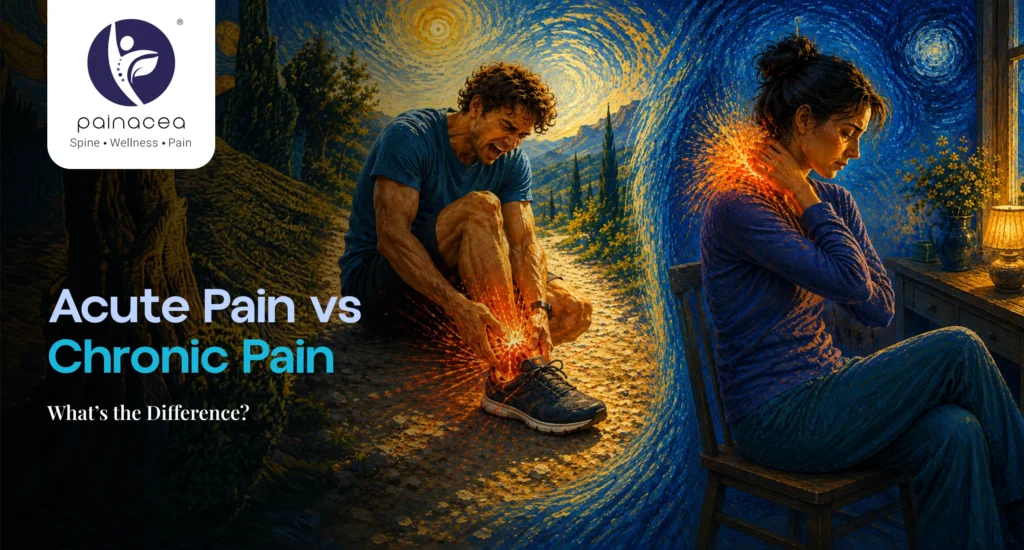
A sprained ankle, pain after surgery and back pain continuing for several months are all forms of pain but they are not necessarily the same type of problem.
Acute pain usually begins recently and is often related to an injury, illness, operation or other medical condition.
Chronic pain persists or repeatedly returns for more than three months. IASP uses this three-month threshold to distinguish chronic pain, while recognising that the cause, expected healing time and clinical course also matter.
One important point:
Acute versus chronic describes the time-course of pain. It does not, by itself, determine the treatment.
At Painacea, treatment is based on why the pain is occurring, how it is affecting function, and whether there is an identifiable pain generator not simply how long it has been present.
Acute pain usually begins recently and may occur because of:
Acute pain often has a protective role by drawing attention to actual or threatened tissue injury. IASP educational material commonly describes acute pain as lasting from a short duration up to approximately three months.
It may feel:
As the underlying injury or illness improves, acute pain often improves as well.
However, severe pain is not necessarily chronic pain. A kidney stone, fracture or acute nerve compression can produce extremely severe pain over a short period.
Chronic pain is pain that persists or repeatedly returns for more than three months.
It may:
Examples include:
Pain continuing after tissue healing does not mean that the pain is imaginary.
Chronic pain is multifactorial, and biological, psychological and social factors can all influence its intensity and impact.
Chronic pain may be primary, secondary, or a combination of both. NICE specifically recognises this distinction.
Chronic primary pain is persistent pain associated with significant distress or interference with daily life that is not better explained by another chronic pain condition.
Examples may include some chronic widespread-pain conditions.
Chronic secondary pain occurs in association with another condition, for example:
Why does this matter?
Because a treatment recommended for chronic primary pain should not automatically be applied to every chronic pain condition. NICE NG193 assesses all chronic pain but its specific treatment recommendations are primarily directed towards chronic primary pain.
| Feature | Acute Pain | Chronic Pain |
| Time course | Recently developed | Persists or recurs >3 months |
| Typical onset | Often sudden | May develop gradually or follow acute pain |
| Common context | Injury, illness, procedure | Ongoing disease, nerve injury, persistent pain mechanisms |
| Examples | Sprain, fracture, postoperative pain | Osteoarthritis, neuropathic pain, persistent back pain |
| Effect on life | Usually temporary limitation | May affect sleep, mobility, work and quality of life |
| Main treatment goal | Treat cause and support recovery | Diagnose pain mechanism, improve pain and function |
Pain intensity does not determine whether pain is acute or chronic.
Yes.
Pain following an injury, illness or operation sometimes continues beyond the expected recovery period.
Contributing factors may include:
Their importance varies substantially between patients.
Reassessment is reasonable when pain:
Back pain demonstrates why duration alone does not reveal the diagnosis.
Recent back pain may follow:
Many uncomplicated episodes improve without advanced investigation or intervention.
Persistent or recurrent back pain may involve:
A finding on MRI does not automatically prove that it is causing pain. NICE advises against routine imaging for uncomplicated low-back pain in non-specialist settings when imaging is unlikely to change management.
There is no single scan or blood test that explains every type of pain.
Assessment may include:
Examination may assess:
Investigations such as X-rays, MRI, CT, ultrasound, blood tests or nerve studies are selected when they are likely to answer a relevant clinical question.
More tests do not automatically mean a better diagnosis.
Treatment depends on the cause.
Depending on the condition, treatment may include:
Complete rest may be appropriate for certain injuries but unnecessary or counterproductive for others.
Medication should also be individualised according to age, other illnesses, pregnancy, kidney and gastrointestinal health and other medicines.
The treatment focus often becomes broader.
Depending on the diagnosis, chronic-pain management may include:
For chronic primary pain specifically, NICE recommends exercise and considering CBT [Cognitive Bahavioural Therapy] for pain or acceptance and commitment therapy as part of an individualised care plan.
These treatments do not imply that pain is imaginary.
MIPSI stands for Minimally Invasive Pain and Spine Interventions.
The Indian Society for the Study of Pain describes MIPSI as a structured domain of image-guided interventions used to diagnose and treat appropriately selected pain conditions involving the spine, peripheral nerves and musculoskeletal system, among others.
The important point is:
Pain becoming chronic does not automatically create an indication for a procedure.
MIPSI becomes relevant when there is a clinical diagnosis, an appropriate target and a reasonable therapeutic or diagnostic purpose.
Depending on the condition, options may include:
May help determine whether a particular nerve or joint is a significant pain generator.
May be used in selected spinal nerve-root pain conditions.
May be considered for appropriately diagnosed facet-joint, sacroiliac or other selected pain conditions.
May be considered for selected focal peripheral-nerve pain conditions.
Vertebroplasty or kyphoplasty may be considered for selected painful vertebral compression fractures.
Selected disc or nerve-compression conditions may be evaluated for minimally invasive endoscopic treatment.
Selected persistent neuropathic pain may be evaluated for:
MIPSI therefore represents targeted treatment after diagnosis, not simply an alternative way of giving painkillers.
Another misconception is that interventions are only for chronic pain.
The acute/chronic classification does not decide whether intervention is appropriate.
For example, selected acute conditions may require:
Similarly, some chronic pain is best managed without any intervention.
Diagnosis determines treatment – not the calendar.
Pain-specialist assessment may be useful when pain:
Seeing a pain physician does not mean that an injection will automatically be performed.
The next step may instead be:
Having chronic pain does not prevent a person from developing a new medical emergency.
Seek urgent or emergency assessment for new symptoms such as:
For back pain, urgent assessment is particularly important with:
New or rapidly changing symptoms should not automatically be attributed to an existing pain condition.
The aim is usually to:
The goals may include:
Complete elimination of pain is not always possible, but meaningful improvement in function can still represent successful treatment.
Painacea is neither medicine-only nor procedure-first.
Our approach is:
Understand the pain → identify the diagnosis and mechanism → determine the pain generator where possible → choose the least invasive appropriate treatment → use MIPSI when indicated → involve surgical or other specialties when required.
Whether pain has lasted three days or three years, treatment should follow the diagnosis.
A consultation does not mean that an injection or procedure will automatically be recommended.

Dr. (Prof) Sidharth Verma is an interventional spine and pain physician with over 17 years of experience in treating chronic pain patients. His work focuses on a precision-driven, minimally invasive approach. His clinical work is centered on Minimally Invasive Pain & Spine Interventions (MIPSI), involving image-guided techniques for targeted pain management.
Dr. Sidharth Verma
15th August, 2026

Dr. Sidharth Verma
15th August, 2026

Dr. Sidharth Verma
14th August, 2026
A consultation can help determine appropriate next steps based on your condition.
125, B wing, First floor, Shrikant Chambers, Next to RK Studios, Chembur, Mumbai, Maharashtra 400071


