

Dr. Sidharth Verma
22nd June, 2026
6 min
Reviewed By:
Dr. Sidharth Verma | 12+ Years Of Experience Treating Pain | Pain Management Specialist
Last Updated: 3rd June, 2026
Neck pain is incredibly common, and most of the time it can be traced back to muscle tension, poor posture, or a bad night’s sleep. But sometimes the pain is pointing to something more structural. A cervical disc herniation is one of the more significant causes of neck and arm pain, and it often goes unrecognised for longer than it should.
Understanding what a herniated disc in the neck actually looks like from a symptom perspective can make a meaningful difference. It helps you take the right steps sooner rather than waiting out pain that is not going to resolve on its own.
This guide walks you through the seven key signs that your neck pain could be a cervical disc herniation, what is happening in your spine when a disc herniates, and what to do about it.
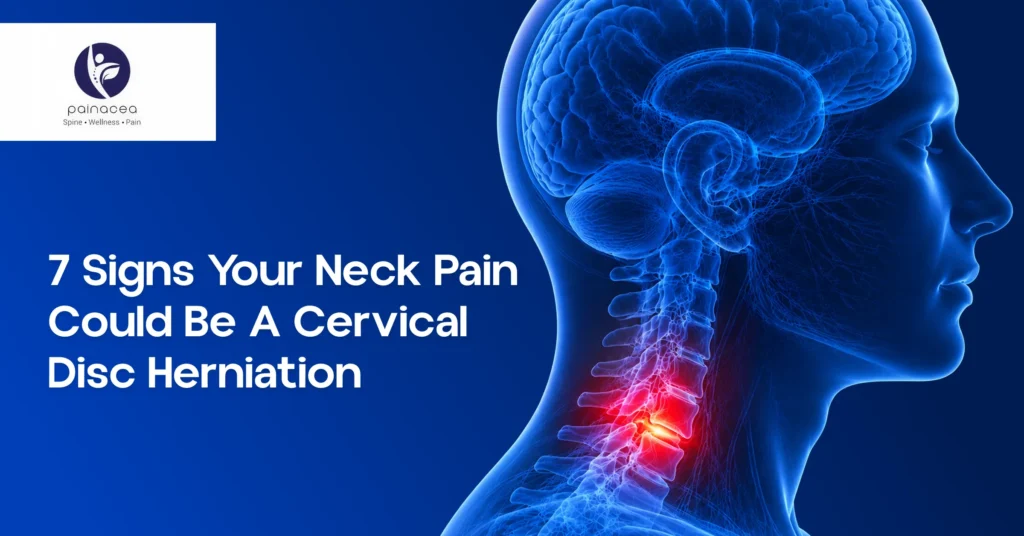
Your cervical spine, the section of your spine running through your neck, contains seven vertebrae stacked on top of one another. Between each pair of vertebrae is an intervertebral disc, which has a hard outer ring called the annulus fibrosus and a soft, gel-like center called the nucleus pulposus.
These discs act as shock absorbers, cushioning your vertebrae during everyday movement. When the outer ring develops a tear or weakens, the soft inner material can push through. This is what is known as a herniated disc, sometimes also referred to as a slipped or ruptured disc.
When that displaced disc material presses on a nearby nerve root or, in more severe cases, on the spinal cord itself, it produces the symptoms described below. The discs most commonly affected are at the C5-C6 and C6-C7 levels, which are the two lowest segments of the cervical spine.
Disc-related neck pain tends to arrive sharply and without an obvious trigger, unlike the gradual ache of muscle strain. It often worsens with specific neck movements like bending forward or rotating and eases with rest. In some cases, arm symptoms are more prominent than neck pain itself.
When a herniated disc compresses a nerve root, pain travels along the entire length of that nerve into the shoulder, arm, and fingers. The pattern depends on which disc is affected.
Common patterns:
This arm pain is often described as sharp, burning, or electric in quality.
Tingling and numbness signal that nerve function is being disrupted. The location of the numbness typically follows the pattern of the compressed nerve root, which helps clinicians identify the level of herniation. Intermittent tingling that worsens with certain neck positions is a common early sign.
Weakness indicates that the motor function of the nerve root is being affected, not just the sensory pathway.
It may show up as:
Progressive weakness in the arm or hand warrants prompt medical evaluation.
Pain or tingling that shifts depending on how you hold your neck is a strong indicator of nerve involvement.
Common patterns:
Turning the head, looking upward, or rotating side to side may feel uncomfortable or limited. The surrounding muscles often go into spasm as a protective response, adding to the overall stiffness. This differs from arthritic stiffness in that certain movements specifically aggravate symptoms rather than simply feeling tight.
This is the most serious sign and requires urgent attention. It suggests the spinal cord itself may be compressed, a condition called cervical myelopathy.
Signs to watch for:
If any of these are present alongside neck pain, do not delay seeking specialist care.
Recognising the symptoms is important, but a proper diagnosis requires clinical assessment and imaging. An MRI scan is the gold standard for diagnosing cervical disc herniation, as it can clearly show the discs, nerve roots, and spinal cord in detail.
The good news is that the majority of people with cervical disc herniation improve with conservative treatment. Research indicates that approximately 75% of patients with acute cervical radiculopathy experience significant pain reduction without surgery within six weeks of appropriate management.
Conservative treatment typically includes the following:
Surgery is generally considered only when conservative treatment has not provided adequate relief after an appropriate period or when there are progressive neurological deficits such as worsening weakness or signs of spinal cord compression that require urgent decompression.
If any of the symptoms in this article sound familiar, do not wait it out. The team at Painacea specialises in diagnosing and treating cervical disc conditions so you can get the right answers and the right treatment. Book your consultation today.
Most cases of cervical disc herniation can be assessed in a planned outpatient setting, but some situations require more urgent attention.
Seek prompt medical care if you experience:
These symptoms may indicate spinal cord involvement, which requires timely assessment to prevent permanent neurological damage.
Neck pain that is sharp, radiates into the arm, or comes with tingling and weakness is not something to dismiss as a pulled muscle. These are the hallmark signs of cervical disc herniation, a condition that is very treatable when identified and managed correctly.
The earlier the right diagnosis is made, the more options are available and the better the outcome tends to be. If your neck pain has moved beyond general stiffness and into the patterns described above, getting a proper clinical assessment is the most important next step.
The most common symptoms include neck pain, pain radiating into the shoulder or arm, tingling or numbness in the hand or fingers, and muscle weakness in the arm. The specific pattern of symptoms depends on which nerve root is being compressed.
Yes. In some cases, arm symptoms such as tingling, numbness, or weakness are more prominent than neck pain. This is because the disc is pressing on the nerve root rather than causing significant local inflammation at the disc itself.
Diagnosis is based on a clinical assessment of symptoms and a physical examination, supported by imaging. An MRI scan is the most accurate tool for confirming the diagnosis, as it clearly shows disc material, nerve roots, and the spinal cord.
No. The majority of cases improve with conservative treatment, including physical therapy and medication. Surgery is typically considered only when conservative treatment has failed after an appropriate period or when there are progressive neurological deficits.
Cervical radiculopathy occurs when a herniated disc compresses a nerve root, causing pain, tingling, and weakness in one arm. Cervical myelopathy occurs when the spinal cord itself is compressed, producing symptoms in both arms or both legs or affecting coordination and balance. Myelopathy is the more serious condition and requires prompt specialist assessment.

Dr. (Prof) Sidharth Verma is an interventional spine and pain physician with over 17 years of experience in treating chronic pain patients. His work focuses on a precision-driven, minimally invasive approach. His clinical work is centered on Minimally Invasive Pain & Spine Interventions (MIPSI), involving image-guided techniques for targeted pain management.
Dr. Sidharth Verma
22nd June, 2026

Dr. Sidharth Verma
4th June, 2026

Dr. Sidharth Verma
1st June, 2026
A consultation can help determine appropriate next steps based on your condition.
125, B wing, First floor, Shrikant Chambers, Next to RK Studios, Chembur, Mumbai, Maharashtra 400071


